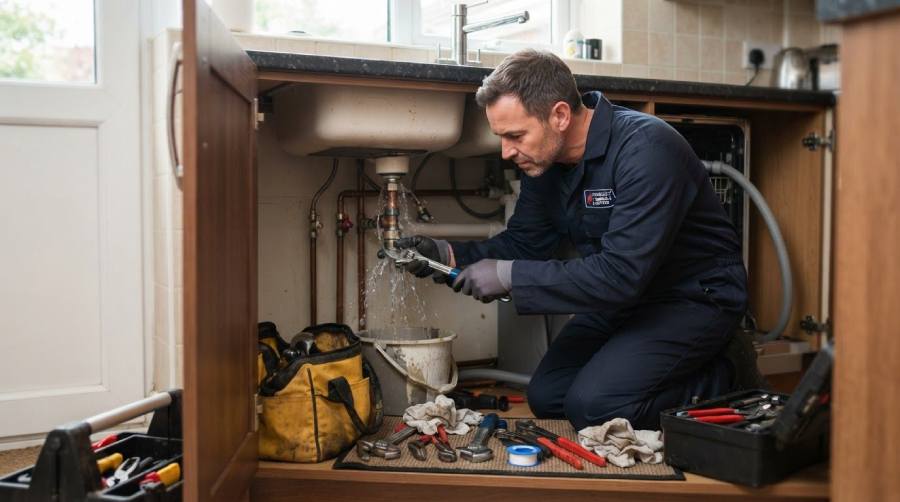
A failed washing-machine hose can release dozens of litres of water in minutes, while a blocked toilet may become a hygiene hazard if wastewater starts rising. Knowing what to do first can limit damage and help a plumber diagnose the fault faster.
Reliable guidance from Plumbing Heroes starts with separating immediate risks from repairs that can safely wait. The right response depends on the source of the water, its volume, electrical or gas hazards, and whether the property can remain safely occupied.
In the UK, plumbing and heating work also involves important competency boundaries. A qualified plumber may repair water services, but gas appliances and gas pipework must be handled by an engineer registered with the Gas Safe Register. Unvented hot-water cylinders require appropriate G3 certification.
When to Call a Plumbing Professional Immediately
Call for urgent assistance when water is escaping uncontrollably, sewage is backing up, or a failure could cause structural, electrical or health damage. Typical emergencies include:
- Burst pipes, split tanks or major leaks that cannot be isolated.
- Water entering ceilings, walls, electrical sockets or consumer-unit areas.
- An overflowing toilet that continues filling or discharges contaminated water.
- Sewage backflow from toilets, baths, gullies or floor drains.
- Complete loss of mains water where neighbouring properties are unaffected.
- No heating during freezing weather, particularly for older people, infants or vulnerable occupants.
- A boiler fault accompanied by a gas smell, carbon-monoxide alarm or unusual combustion symptoms.
Immediate safety measures
Turn off the internal stopcock, usually located beneath the kitchen sink, near the incoming mains pipe or in a utility area. If the leak is on a storage tank or heating circuit, isolating the stopcock may not stop it, so close the relevant isolation valve if you can identify it safely.
Switch off electricity at the consumer unit only if you can reach it without stepping through water. Do not touch electrical equipment, switches or plugs in a wet area. Move valuables away from the leak and use buckets, towels or wet vacuums to contain water, but do not dismantle pressurised systems.
If you smell gas, avoid flames, switches and electrical devices. Leave the property, call the National Gas Emergency Service on 0800 111 999, and do not attempt a boiler or gas-pipe repair.
A dripping tap, slow basin, noisy radiator or toilet that still flushes can generally be booked as a standard repair. A tenant should report emergencies to the landlord or managing agent immediately and follow the tenancy’s out-of-hours procedure. Homeowners should document damage with photographs, while landlords should preserve invoices and certificates for insurance and compliance records.
Plumbing and Heating Services for UK Homes
Domestic plumbing work commonly includes leak tracing, pipe repairs, replacement taps, toilet mechanisms, shower valves, waste traps, blocked sinks, radiators and kitchen or bathroom alterations. A methodical plumber may begin by checking pressure, isolation valves, visible joints and appliance connections before opening walls or floors.
Hidden leaks require a more structured diagnostic process. Moisture meters, thermal imaging cameras, acoustic listening equipment and tracer gas can help locate failures beneath floors or behind finishes. A written report with photographs may be useful for an insurer, although acceptance depends on the policy.
Older homes may contain lead service pipes or lead stopcocks. Replacing a defective stopcock can improve isolation and remove a potential source of lead exposure, but drinking-water concerns should also be discussed with the local water supplier. Never disturb suspect materials unnecessarily.
Heating and hot water
Heating specialists may diagnose:
- Boiler ignition, pressure, pump, diverter-valve and condensate faults.
- Central-heating circulation problems, cold radiators, sludge and balancing issues.
- Hot-water cylinder, immersion-heater and programmer faults.
- Smart controls, zoning and compatibility with systems such as Nest, Hive or Tado.
- Underfloor heating manifolds, actuators, pumps and temperature controls.
Gas work—including boiler servicing, installation, repair, flue work and gas pipework—must be completed by a Gas Safe registered engineer. Check the individual’s registration card and verify that the listed qualifications cover the specific appliance work.
Unvented cylinders operate at mains pressure and require an engineer with the relevant G3 qualification. Underfloor heating may be wet, using pipe loops and a manifold, or electric, using cable or mats; each has different controls, testing requirements and running costs.
Landlords must arrange an annual gas safety check for relevant gas appliances and flues, provide tenants with the record within the required timeframe, and retain documentation. A boiler service is not automatically the same as a legally compliant gas safety check.
What a Professional Plumbing Visit Should Look Like
The first call should establish the fault, property location, access arrangements, parking restrictions, visible damage, affected fixtures and whether water, gas or electricity has been isolated. Photographs or a short video can help distinguish a failed flexi-hose from a concealed leak, although remote estimates are not definitive.
A transparent visit normally follows this sequence:
- Inspection and safe isolation.
- Explanation of the probable cause and available repair options.
- Agreement on the price, rate or diagnostic charge before non-essential work begins.
- Repair using correctly rated parts and suitable jointing methods.
- Testing under operating conditions, including leak checks and boiler safety procedures where relevant.
- Clear aftercare advice, invoice and information about any guarantee.
Fixed pricing can offer certainty for a defined task, such as replacing a tap or clearing a straightforward blockage. Hourly pricing may be fairer where fault-finding is unpredictable. A diagnostic charge is reasonable when specialist equipment or substantial investigation is required, but it should be explained in advance.
Customers should expect dust sheets, tidy working practices, safe disposal of replaced parts and prompt communication if the scope changes. Emergency engineers may prioritise containment rather than completing a permanent reinstatement on the first visit; that limitation should be made clear.
Plumbing Costs, Qualifications and Customer Protection
UK plumbers commonly charge an hourly rate, often roughly £40–£80 before materials, with higher rates in London and other high-cost areas. Emergency, evening, weekend and bank-holiday attendance can add a premium. Some firms use a call-out fee, while others apply a minimum charge or fixed price.
Costs vary because of access, diagnosis, parts, parking, property age and the consequences of failure. Broad market patterns include:
- Routine tap, toilet or trap repairs are usually relatively low-cost when access is straightforward.
- Leak detection costs more when thermal, acoustic or tracer-gas equipment is required.
- Drain unblocking ranges from a basic mechanical clearance to higher-cost jetting or camera surveys.
- Boiler repairs depend heavily on the failed component, appliance age and parts availability.
- Replacement boilers, cylinders, radiators and heating controls involve design, commissioning, compliance and disposal, not just labour.
Treat online prices as indicators rather than promises. A very low call-out fee may exclude diagnosis, materials, VAT or the first hour.
Before booking, check:
- Public liability insurance and, where relevant, employers’ liability insurance.
- Trade qualifications appropriate to the work.
- Gas Safe registration for gas tasks, verified through the official register.
- G3 competence for unvented-cylinder installation or servicing.
- Written quotations, payment terms and workmanship guarantees.
- Receipts, commissioning records and certificates.
Do not authorise additional work without a revised price or written approval. If something goes wrong, contact the contractor first, retain evidence and use relevant consumer-protection or dispute-resolution routes. For gas safety concerns, contact Gas Safe Register or the emergency service rather than relying on informal repairs.
Choosing the Right Plumbing Team for Your Situation
Start with the problem, not the advertising language. A water leak needs plumbing competence; a boiler or gas appliance needs Gas Safe coverage; an unvented cylinder needs G3 competence; commercial, healthcare and managed properties may require planned maintenance, method statements and enhanced hygiene controls.
Ask before booking:
- Is attendance available within the required timeframe?
- What are the call-out, diagnostic and out-of-hours charges?
- Can the engineer give an estimated timescale and likely parts requirement?
- Is the work completed by employed staff or subcontractors?
- What guarantee applies, and will the invoice include certification?
- Can the team work around tenants, patients, customers or business operations?
Reviews are useful when they describe comparable work rather than simply praising speed. Look for evidence of clear communication, clean workmanship, accurate paperwork and effective follow-up. Local experience can also matter: older terraces may have lead pipework and obsolete valves, while cold spells can expose weak protection against frozen pipes. In areas with hard water, scale can affect shower valves, cylinders and heating components.
Booking checklist
Have the following information ready:
- A concise description of the fault and when it began.
- Photographs or video showing the affected area.
- The stopcock and boiler locations, if known.
- Whether water, gas or electricity has been isolated.
- Property access details, parking restrictions and tenant contacts.
- Your preferred contact method and availability.
- Any relevant appliance model, error code, warranty or previous repair record.
Prompt isolation, accurate information and properly verified competence are the foundations of safe plumbing assistance. They reduce damage, prevent avoidable delays and make it easier to agree a fair repair.
