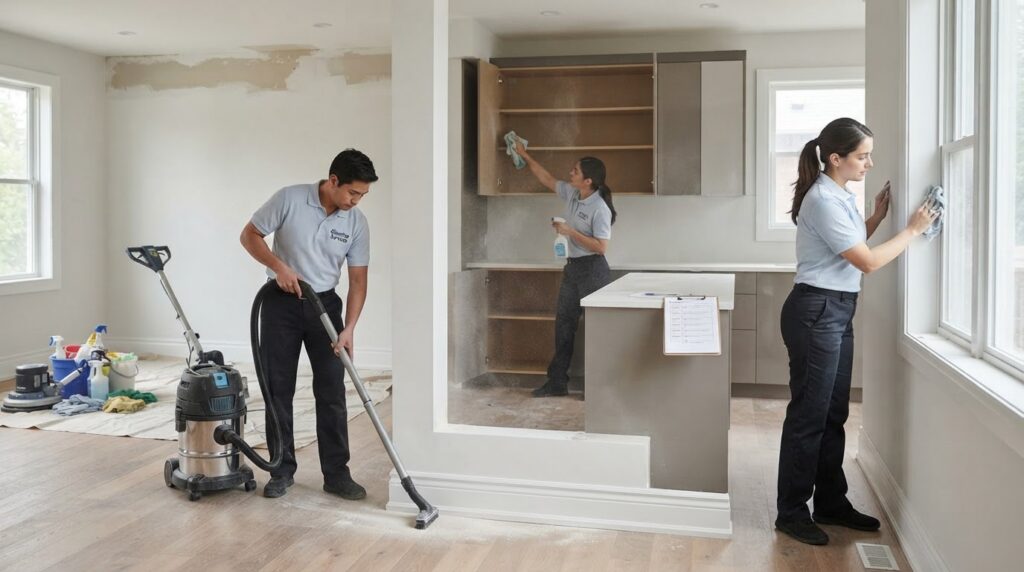
Renovation dust rarely stays where the work happened. Plaster, gypsum board dust, and cement residue travel through open doorways, settle on every horizontal surface, and work their way into cupboards, ducts, and seals. Many homeowners only notice the problem once the last trade has left and the rooms look finished but feel gritty underfoot.
Many homeowners begin their planning with After Builder Cleaning company near me and then discover that the right scope, timing, and preparation matter as much as the price. Understanding how post-construction work differs from routine cleaning helps you judge quotes, schedule the job sensibly, and recognise a finished result when you see one.
This guide explains where renovation debris hides, how to sequence the clean around remaining trade work, what drives cost, how to prepare access, and how to inspect the handover.
Where Renovation Dust Hides and Why Routine Cleaning Misses It
Construction dust is not one substance. Drywall sanding produces fine gypsum particles, while cutting masonry, screeding, and chasing walls can release crystalline silica. The Health and Safety Executive treats respirable crystalline silica as a serious occupational hazard, which is one reason site dust is controlled at source and why residue left in a home should be removed with equipment designed to capture fine particles rather than redistribute them.
Fine dust settles in places a standard domestic clean seldom reaches:
- Above wall units and the tops of kitchen cabinets
- Inside supply and extract vents, and around grilles
- Behind and beneath fridges, freezers, and washing machines
- On window reveals, picture rails, and the tops of door frames
- In the gaps around sockets, skirting, and架 fittings
Domestic or spring cleaning focuses on lived-in surfaces: dusting, wiping, and vacuuming to maintain appearance. A post-construction clean is a different job. It targets adhered residue, paint splashes, plaster films, and adhesive marks, and it assumes that the dust has been disturbed by building activity rather than ordinary use. Using a standard vacuum on plaster dust often exhausts fine particles back into the room, which is why professional teams typically use HEPA-filtered vacuums, microfibre systems, and detergents formulated for construction residue. Those products are intended for professional use and are handled under COSHH assessments, which require the provider to document hazards and controls.
Timing the Clean Around the Final Stages of Building Work
The sequence matters more than most homeowners expect. The best result usually comes when the clean follows the final trade visit by roughly 24 hours. This interval allows any residual dust to settle after the last disturbance and gives plasterers, electricians, and plumbers time to finish their work without leaving new residue behind.
If other work is still scheduled, the calculation changes. Partial or room-by-room cleans are possible, and some providers will clean a single room or floor while the site is still active. The trade-off is straightforward: any dust generated later in the programme can resettle on freshly cleaned surfaces. A kitchen cleaned before the flooring is laid will often need a light second pass after installation.
Paint, plaster, and varnish timing also affects the booking. Plaster needs adequate drying before decorators apply finishes, and emulsion or varnish needs time to cure before it can tolerate cleaning agents. Cleaning too early can leave residue on surfaces that are still curing, while cleaning after decoration but before furniture and flooring is installed often gives the cleanest final surfaces. A practical sequence looks like this:
- Complete structural and wet trades, then allow plaster to dry
- Finish decorating and allow paint and varnish to cure to the manufacturer’s stated time
- Book the post-construction clean
- Install flooring, fittings, and furniture, followed by a light touch-up clean if needed
What Shapes the Price and Which Add-Ons Are Worth Considering
Quotes vary because the work varies. Published London ranges commonly start around £160 and can reach £650 or more for larger properties with heavy debris, though these figures are indicative rather than fixed.
Factors That Move the Quote
- Property size and layout: Floor area, number of bathrooms, and the number of rooms with fitted cabinetry all affect labour time.
- Level of debris: Heavy plaster residue, paint splashes, and adhesive marks take longer than fine dust alone.
- Fixtures, windows, and floors: Internal window washing, hard-floor scrubbing, and detailed cleaning of fitted units add time.
- Out-of-hours timing: Evening or weekend slots usually carry a premium.
- Parking, congestion charges, and location: Properties within the central London Congestion Charge zone can add charges, and some providers apply surcharges outside their core postcodes.
Add-Ons Homeowners Often Overlook
- Carpet and upholstery treatment: Hot-water extraction removes embedded plaster dust that vacuuming cannot lift. It is usually best carried out after the heavy clean, and carpets should be dry before furniture is returned.
- Oven cleaning: Ovens used during the works often carry plaster and grease residue. Removable racks and trays are normally soaked separately.
- Inside appliance cleaning: The standard service typically covers appliance exteriors. Used white goods that were in place during the works benefit from interior cleaning.
Whether extras are necessary depends on the property. In a new build, appliances are often unused and may need only an interior wipe, while the main risk is plaster and dust in ventilation and fittings. In an older property being refurbished, appliances, carpets, and soft furnishings are more likely to have been exposed to sustained dust, so the add-ons carry more value.
Preparing the Property and Your Access Before the Team Arrives
Failed visits usually come from access problems rather than cleaning problems. Before booking, confirm the following:
- Keys and entry: Decide whether the team will use a keyholder, a key safe, or a neighbour. Provide key safe codes in writing and confirm which party is responsible if access fails.
- Building management: Flats and managed developments often require advance notice, lift bookings, and approval for use of communal areas and waste chutes.
- Parking: Check whether permits or suspensions are needed for a van outside the property. Some providers will add parking fees to the final invoice if agreed in advance.
- Neighbours: If the team needs to access a neighbouring key or park across a shared driveway, inform the neighbour in advance.
Utilities are equally important. Professional vacuums, scrubbers, and extraction machines rely on electricity, and carpet extraction requires hot water. If the property has no working mains supply or the boiler is disconnected, ask the provider in advance whether the team can work with alternative power or whether the booking should be rescheduled. A failed utility check on arrival usually means a wasted visit.
Clear surfaces where possible. Remove loose items from worktops, shelving, and floors, and move any stored furniture away from walls. Teams cannot clean behind heavy items they cannot move safely.
Tell the provider about allergies or sensitivities at the time of booking. Ask for product information and the relevant COSHH documentation if you have a respiratory condition or a sensitivity to fragrance. Reputable providers can usually substitute alternative detergents, but they need the information before the job begins.
Inspecting the Result and Knowing the Limits of the Clean
Inspect the property with the team present where possible, and use a consistent checklist:
- Windows, frames, and sills, including the tops of frames and the corners
- Skirting boards and the joints between skirting and floor
- Cabinet tops and the tops of wall units
- Appliance exteriors, including the seals and surrounds
- Carpets, checking for embedded dust near walls and doors
- Hard floors, including the edges and corners where dust collects
- Vents and grilles, checked for visible residue
Professional cleaners cannot remove everything. Paint spillages on certain flooring are a common limit: laminate, engineered wood, and some resilient finishes can be damaged by solvent-based removers or aggressive scraping, so a cleaner may decline the work to avoid causing harm. Where paint has bonded to glass or tiles, a cleaner can often remove most of it, but fine residue may remain. Scratches, chips, paint that has soaked into porous surfaces, and damage from the works themselves are generally the builder’s responsibility rather than the cleaner’s. If damage was caused during construction, raise it with the builder before the clean, not after.
Report problems quickly. Most providers set a limited window for complaints, often 24 to 48 hours. Photograph the affected areas with timestamps, note the room and surface, and report in writing so there is a clear record. Ask how the provider will respond: whether a return visit is included, whether the fault will be corrected at no charge, and who to contact.
A reputable provider should be able to confirm its staff vetting and experience. Ask whether the team completes enhanced DBS checks and right-to-work verification, whether staff have completed recognised cleaning training (the British Institute of Cleaning Science is one body that offers qualifications), and whether the business carries public liability insurance. If you require construction-site experience, ask whether staff hold CSCS cards, and confirm the business’s CIS status if it is working as a subcontractor.
A clear handover is the final test. If the property looks finished, feels dust-free at ground level, and the checklist has been worked through, the clean has done its job. If it has not, the sooner the issue is reported, the easier it is to resolve.
